



Rehumanizing the Family Office

The idea of machines overthrowing and displacing humans has long been feared. This fear dates to at least 1872 in Samuel Butler’s literary work Erewhon. Then, machines were mere metal gears, yet this fear still festered. The fear was driven by comparing the rate of the evolution of machines vs. the pace of the evolution of humans. Butler states, “What I fear is the extraordinary rapidity with which they are becoming something very different to what they are at present. No class of beings have in any time past made so rapid a movement forward.”

The rapidity of the machines’ evolution still exists today at an even faster pace. We must only look to the technology sector to see this astounding rate of change. Think back to 1969 and the technological marvel of putting humans on the moon. Butler could never imagine machines launching people into space, landing on the moon, walking on it, and capturing the moment with machines that visually record time. Even today, this activity can be challenging to process. Fast-forward to the present, and other than providing you with oxygen, your iPhone has more power than the technology Apollo 11 used. In fact, with 4GB of RAM, it has over one million times more memory than the computers used in 1969—the computers that sent humans to the moon. Impressive, albeit scary, stuff.

Collaboration, Not Competition, is Key to Human-Technology Relationships

This unnatural evolution of technology is understandingly startling to humans. To succeed in this world—to prove our “value”—we must be needed in some capacity. Whether as a guardian, a spouse, an employee, a friend, or a neighbor, it is in our DNA to contribute—to be part of something. This natural desire to be needed causes a fear of being replaced by machines in the workplace. As technology rapidly evolves to be smarter and faster, we feel constrained by our humanness and insecure about our workplace roles. But should we?

What if we were to view our humanness as irreplaceable? Would there then be a battle in the workplace at all? What if, instead of competing with machines, we could leverage the power of technology to create a humanized workplace? Software implementation provides a great example of how technology rehumanizes work and improves employees’ lives. The adoption of new software certainly makes employees more productive (a win for the company). Still, more importantly, it makes their work more enjoyable and fulfilling (a win for the employees). For instance, automation makes employees more efficient and frees them from burdensome, mundane tasks—allowing them to do valuable, rewarding work that requires critical thinking.

A Harvard Business Review article titled “Using Technology to Make Work More Human” discusses this concept:

“What automation can change for the better is the experience of work. Rather than doing the same work faster and with fewer people, smart tech creates an opportunity to redesign jobs and re-engineer workflows to enable people to focus on the parts of work that humans are particularly well-suited for, such as relationship building, intuitive decision making, empathy, and problem-solving.”

When thought of in this way, the fear of technology morphs into an opportunity for us to be better employees. Better coworkers. Better humans.

Family Office Software Helps Humans Flourish

Through the lens of family office personnel, the benefit of software as a tool to increase value becomes abundantly clear. Let’s consider a day in the life of a family office employee. To start, the employee is not only well-educated and experienced, but the family also trusts them. More so than in other industries, this trust is paramount within a family office. Although the modern family office employee generally fulfills many roles, their overall objective is to maintain, access, and report on data. From bill pay to investments to taxes, family office personnel are responsible for recording and communicating accurate financial information. At the highest level, it is valuable work. But when examined closely, the nightmare of “a day in the life” reveals itself: These trusted, high-value employees are bogged down in data entry, spreadsheets, and disparate software—the antithesis of human work.

Antiquated systems lead to inefficient processes and inundate valuable employees with low-value work. Furthermore, they increase the chances of data inaccuracies. This is detrimental to family office employees as nothing erodes trust quicker than producing inaccurate information to family members. The work that goes into ensuring accuracy is not only unenjoyable, but it is also better suited for technology to manage. Machines are perfect for ensuring accuracy, optimizing processes, and enforcing best practices and workflows. By letting machines do the work they were optimized to do, employees are able to reconfigure their time to spend on value-added tasks. So then, why do family offices function this way?

Compared to other industries, family offices have been slow to technologically evolve. Such slow progress is unfortunate because the structure of a family office is ideal for advanced software technology. Although every family office is different, the tasks they accomplish are generally the same. Based on decades of experience working in family offices, Eton Solutions has mapped all business processes in a family office and found more than 270 processes. Most family offices execute these tasks manually. This is time-consuming, tedious, and error-prone with disparate data and manual workflows.

Although the family office industry has not fully taken advantage of it, the technology does exist to automate these workflows and greatly reduce risk. A truly integrated platform, like AtlasFive®, embeds these processes and workflows into the software so they can be executed seamlessly. By transforming the core of how a family office functions, employees can continue to build trust, produce more accurate work, and find time to do more fulfilling, valuable tasks.

Access our brochure on AtlasFive which describes how Eton Solutions has begun to rehumanize the family office or request to see the platform live.

Family Office Cybersecurity

Across multiple surveys of family office software users, cybersecurity is consistently the single most important and commonly identified item of concern. The potential breach of the family office IT system and the loss of confidential data keep many family office personnel up at night.

And for a good reason. A Boston Private survey titled Surveying the Risk and Threat Landscape to Family Offices found that 26% of family offices have suffered a cyberattack. While traditional security frameworks focus on meeting compliance obligations and preventing unauthorized access to confidential data, cybersecurity in 2022 is more complex—and more comprehensive. Protecting against data breaches and the loss of confidential data is merely one component of a complete and multifaceted cybersecurity framework.

Just as the family office role has evolved over the years, so have its responsibilities. Today, family offices offer clients more than just features and functions. Family offices also must provide the necessary infrastructure, industry certifications, and operations to support the secure and certified operations that their clients demand. Family offices must demonstrate that their clients’ highly confidential data is secure and that their operations support disaster recovery and world-class business continuity.

Family office software companies now must take a more holistic approach to protect family offices from a host of business threats, including cyberattacks, data breaches, and internal and external bad actors—while at the same time dealing with compliance, audits, and governance obligations. Judicious companies recognize they must provide their clients with access to the latest cybersecurity advances while also maintaining greater control over client data—and still offering clients flexibility in their security operations.

The family office’s scope extends beyond its software and data in today’s connected world. Multi-family offices (MFOs) want to offer seamless access and integration (APIs) into their various clients’ internal systems. Their clients want to use these APIs to access governance and use logs to integrate into their corporate compliance and governance tools.

As a result, MFOs want cybersecurity frameworks that are more dynamic and more flexible. Of course, they expect state-of-the-art security of data and systems. But modern MFOs also aim to use these capabilities to differentiate their services and better position their offerings for their clients, highlighting it during the sales cycle to win new deals. In addition, they use their SaaS providers’ infrastructure and offerings to meet their contractual obligations, like pen tests, SOC2 compliance, confidential data access tracking, and more.

Essential family office cybersecurity requirements expected from the family office SaaS provider include the following:

  • Flexibility that Accommodates Different Security Needs: The software providers recognize that one security model does not fit all. Some family offices have very sophisticated requirements and need family office software that seamlessly integrates into their identity use compliance and monitoring frameworks. Others require that family office SaaS inherently offers a secure and managed security service, including SOC 2 compliance and security incident management.
  • Managed Family Office Cybersecurity Services: Security and compliance are top concerns for organizations moving to the cloud. With a SaaS solution, the SaaS provider handles patching, maintenance, and security vulnerabilities, which relieves the family office of this responsibility and substantially reduces the family office’s operational burden and risk. Imagine not having to worry about whether the family office InfoSec team (which is also generally less experienced than an InfoSec team at a SaaS organization) applied the latest patch to fend off a recent viral software vulnerability or malware that’s bringing down internet services. These managed services include disaster recovery and business continuity support, which mitigates additional risk for the office.
  • Inheritable Maturity (Complying with Industry Security Standards and Meeting Statutory and Contractual Obligations): Many family office software customers require compliance with accepted industry standards like SOC 2, ISO 27001, and others. Family offices also must meet national sovereign data residency requirements. In addition, they need to comply with data protection acts like GDPR in the EU, CCPA in California, and the NY DFS. Inheritable maturity allows family offices to inherit their SaaS provider’s infrastructure and security maturity and certifications while leveraging it for their own business goals.
  • Client Control over Data: To meet the varying needs of their clients, family offices must join other FinTech companies that allow clients to supply their own encryption key, i.e., Customer Supplied Encryption Key (CSEK). Family offices utilize CSEK to have 100% confidence in data control and assure their clients that only authorized personnel can access their data since they control the encryption keys. In addition, MFOs want the flexibility to segregate the different client data that is managed by various partners using separate unique encryption keys for each client and relationship.
  • Transaction-level Access Monitoring that Integrates with Clients’ Governance Tools: SFO/MFO SaaS providers need to provide excellent transactional-level access monitoring. This allows their clients to meet governance obligations of tracking confidential data access. Their clients want to extract these access logs and integrate them with their governance and compliance reports and tools to monitor access. With this dynamism and enhanced capabilities, customers can track and analyze transactions with greater granularity and integrate this metadata and telemetry into additional governance and reporting capabilities. These reports and analytics help improve governance and better understand user behavior.
  • Cloud-Native Security that allows Sophisticated Authorization and Access Protocols: A cloud-native Azure Active Directory integration, like in AtlasFive®, enables a team to support very complex requirements from their clients—complexity that isn’t possible with traditional SSO models. For example, a global financial institution may want to separate their SSO authorization model for their users from the authorization model for their client logins. A top-tier security framework will allow this institution to have three separate security domains: one for users to access the family office platform, another active directory for clients (separating them from the internal active directory), and a third for the operations team managing their SaaS system.

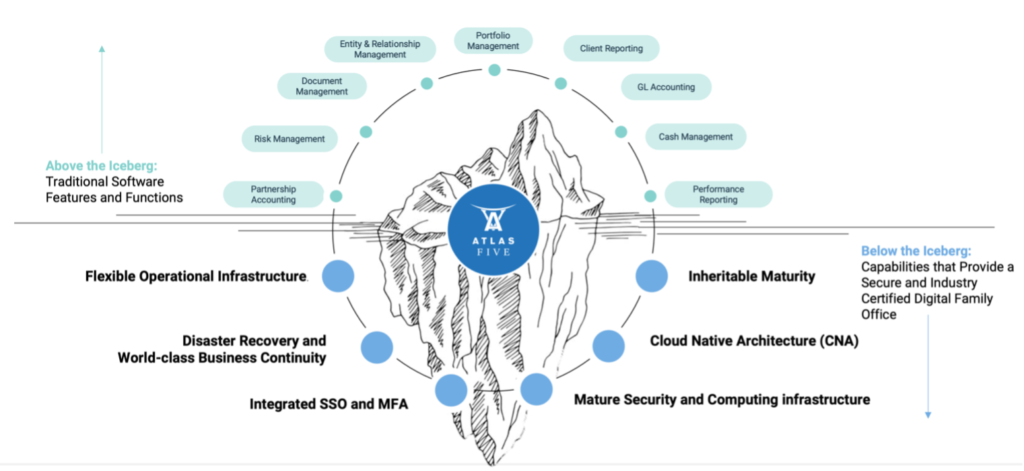
An outline of such a family office cybersecurity framework can be seen below. The software, features, and functions are “above the iceberg,” and security is “below the iceberg.”

To stay relevant, the modern family office will need to evolve its scope of services—and with those new services come new responsibilities. As the family office performs expanding roles for its clients, it must focus on security to ease growing client concerns over data breaches. Family offices understand this client concern, with 57% of family offices from the Boston Private survey having identified cyber risk as one of the most significant risks they face.

Security—and more specifically, cybersecurity—is shifting from an “afterthought” to a keystone of the family office’s sales pitch. Offices that don’t respond to this transition with a flexible digital platform, like AtlasFIve, and world-class security frameworks will become vulnerable and even obsolete. In this new and ever-changing security environment, family offices need more than a family office application; they need a secure, industry-certified digital family office.

A Universal Family Office Platform: Is It Possible?

“Tailor-made” is a popular expression that suggests a great fit for a given need or situation. A great fit can be fantastic if achieving that right fit doesn’t require exorbitant amounts of time, inefficient manual processes, costly custom software development, and too many resources.

For the family office of the future, Eton Solutions® believes achieving the right fit should begin with a standard, best practice business structure that can be optimized depending upon a wide range of factors, such as assets under management, investment focus, family needs, operating jurisdiction, and so on. Other critical challenges, like staffing, can be addressed with the appropriate application of technology and a refined business model. The test for technology is its flexibility in addressing the specific needs of any office.

Such a universal technology platform heralds a new era of a family office. The family office of the future exists on a universal family office platform with a best practice business structure that can be optimized in alignment with the specific needs and factors of the office.

A Custom Solution Using a Common Platform

There’s an adage in the family office world: “When you have seen one family office, you have seen one family office.” In other words, every family office is unique with a singular operations model. This bespoke operating model addresses only the needs of the specific clients it serves, frequently using custom-made software developed only for that organization and supported by various manual processes. This custom-built approach is inefficient and out of date in today’s world. The bespoke analogy brings to mind men’s tailor-made suits, but such suits are based upon common elements and a common approach.

In this day and age, a family office should not rely on significant manual processes or a fragmented set of crudely built point solutions to partially address an office’s needs. The rapid growth in the number of family offices worldwide has facilitated formal and informal networks where offices talk and exchange information. But the key is the actual commonality of the tasks a family office performs. Eton Solutions has mapped and deconstructed these tasks, as the image below shows. The result is a universal operating model supported by a common flexible platform, AtlasFive®, that can adapt to the many factors each office must address.

The mapping and deconstruction of family office tasks.

Let’s take the bespoke men’s suit analogy further. To offer a bespoke suit, a tailor must be very skilled and knowledgeable about what works and what does not when using certain materials to create the best suit possible for a person’s unique body. The map above and the business processes and workflows it incorporates, demonstrate the degree of knowledge needed for a bespoke family office platform—making Eton Solutions an exceptional tailor.

Mastering these processes allows the family office operating model to be adapted for the broadest possible range of requirements, such as the size of the office, the specific focus areas for the family or families it serves, or the regulatory and reporting requirements of the country where it is based.

Bespoke Service for Any Business Model, Anywhere.

For example, Eton Solutions has several family office clients in Canada where regulatory and reporting requirements are different from that of the United States. Many Canadian family offices deal with at least CAD, USD, and EU investments. The base currency for reporting to the family is typically in CAD, but reports are also needed in the investment currency. All this currency conversion is seamless in AtlasFive because it is a universal family office technology platform featuring multi-currency functionality at its core.

In addition, Canada operates on an adjusted cost basis (ACB) for investment in securities. The calculation includes the original purchase price and all costs related to purchasing an item, i.e., those costs incurred before the item/asset is available for use. It is imperative to track and report on the ACB of any investments or property that could result in a capital gain or loss on disposition or deemed disposition.

The ACB of an investment in securities includes the purchase price and any commission paid. It is calculated separately for each security owned. The total cost of all shares of that security owned in all non-registered investment accounts must be calculated and divided by the total number of shares owned in all non-registered investment accounts to get the cost basis per share or weighted average cost per share. This cost per share is then used to calculate capital gains or losses when some or all the investment is sold. There can be adjustments to the ACB when the shares are owned, such as the return of capital (ROC) on mutual funds, exchange-traded funds, or income trusts. ROC reduces the ACB of your shares.

The ability to do this calculation and report on it is a core requirement for a Canadian family office. It is an excellent example of how the AtlasFive best practice business model can be configured to meet a specific use case related to regulations and geography.

A new client in Australia, which will go live in 2022, is another example of the universal validity of the AtlasFive family office business model and its dynamic ability to service any bespoke office. Like our Canadian clients, this office has its own set of regulatory and reporting requirements, all of which are seamlessly supported by AtlasFive.

Bill-Pay Reimagined for the Family Office

Bill-pay in a family office—what does it look like?  The process starts when a product or service is purchased, and the office receives a vendor invoice for payment. That invoice is recorded, validated, approved for payment, and then paid. The process is time-consuming and error-prone for many family offices, involving manual, paper-intensive workflows, multiple point systems, and spreadsheets.

Now imagine bill-pay and transaction processing as a seamless process not dependent on manual work, pieces of paper, manila folders, spreadsheets, or siloed software. Imagine a complete, end-to-end workflow with transparency and auditability at every level all the way through to the movement of money using an integrated payment gateway. This is bill-pay reimagined.

What does a seamless workflow mean within the family office?  It means that all data, like that coming from an invoice, are processed end-to-end through a single integrated platform. An invoice is automatically uploaded into the platform, the document is ‘read’, and details like vendor, amount, date, entity name, etc., automatically populate a pre-formed template. That template has the built-in business “knowledge” around the relationships of all participants needed to record the data properly. It automates time-consuming tasks that are often associated with bill-pay, such as allocating a transaction across multiple legal entities at specific percentages.

The template creates a workflow where humans review and approve the transaction through to payment. This is not the typical review where paper is passed around. When bill-pay is reimagined, like in our platform AtlasFive, the approval steps are embedded in the system and assigned by role and responsibility. If a family member wishes to be involved in any approval workflow, they can participate using the system’s unique client portal or mobile app.

After final approval, a check can be cut, a payment can be added to an ACH payment batch, or a wire process initiated, and all of this is done within AtlasFive without “switching” to a bank portal.

Soon, artificial intelligence (AI) elements will replace the mundane elements of the bill-pay processes, like documents being automatically read and all the data elements for processing and posting completed by AI. The office staff can then do critical work around analysis, oversight, approvals, etc.

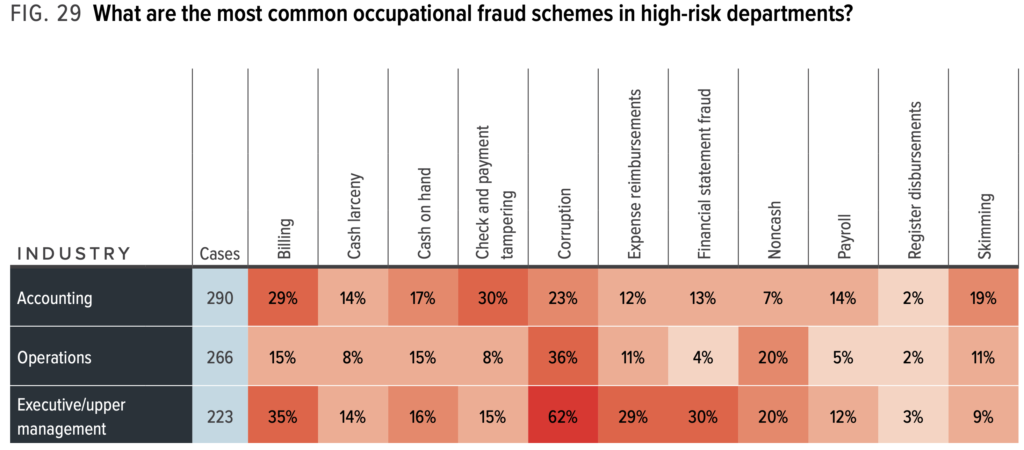
The implications go well beyond efficiency. Fraud occurs in some family offices. The problem most frequently occurs around the movement of money, such as bill payment, because there is too little transparency in the whole process. As the table below shows, fraud can occur across different functions and processes within organizations.

Some figures from 2019 (Assoc. Certified Fraud Examiners):

The key to combatting fraud is a seamless process with real controls, transparency, and risk management. Below are the critical elements needed to achieve this:

  • Segregation of duties (SYSTEM enforced roles and responsibilities)
  • Single point of data entry with maker/checker process for data integrity
  • Automated bank/custody reconciliations with audited exception management
  • Daily reconciliations
  • Automation of transaction-based GL journals (NOT manual)
  • Operationally enforced payments limit and authorizations
  • Maker/checker workflow for manual GL journals
  • Automated reporting (NO spreadsheets!)
  • On-demand audit trail

The old “we have always done it this way” approach, where manual work and disparate software applications are used as systems of record (with a series of spreadsheets as the consolidator and report creator), will never provide the necessary controls.

AtlasFive represents a paradigm shift across virtually all of the work done within a family office. It provides the basis for a lean principles approach with seamless, end-to-end process and workflow for bill-pay and every other task within the office.

The lean process approach and ERP (Enterprise Resource Planning) technology have been used to conquer critical business challenges in many other businesses, providing a highly productive and transparent environment with seamlessly integrated data, processes, workflow, and people. This has allowed businesses to reimagine how they operate. The result is the integration of embedded best practice processes and business rules, together with access to a single source of data. It has dramatically improved visibility and control at multiple levels, including the accounts payable processes around bill-pay.

A significant benefit of lean processes and ERP systems is to eliminate mundane tasks, such as bill-pay, and allow organizations to focus on high-value work like analysis and meeting the goals of business agility and innovation.

Is there an ERP system designed specifically for a family office?  Yes! Check out AtlasFive here.

Reimagining Family Office Cybersecurity and IT Excellence

If your family office is still using on-premises IT infrastructure, such as in-house servers running your applications, you probably are taking significant unnecessary security and compliance risks. You’re also wasting precious time and resources that could be better spent adding value for your family.

Consider the following analogy. In his book “The Big Switch,” Nicholas Carr writes about the transition of businesses from on-premises electrical power plants to the use of third-party electrical grids.  There was a time when many companies operated their own electricity departments, complete with electrical architects and managers. The transition to outsourced power allowed companies to dramatically reduce capital costs, improve power reliability, and refocus labor, management time, and other resources on better running their core business.

Unlike other businesses, many family offices have not made IT a priority. Too often, the result has been a lack of best practices in maintaining cybersecurity, business continuity, and disaster recovery. Today, cloud computing offers family offices an opportunity to remedy this situation. Like the companies of old transitioning to third-party power grids, family offices need to tap into today’s advanced cloud IT infrastructure to reduce their risks and improve operational excellence.

The shift to a complete cloud-based infrastructure may seem daunting for family offices. However, in today’s increasingly digital world, family offices simply must raise their game and utilize modern IT infrastructure to support secure and certified operations. They must demonstrate that their clients’ highly confidential data is secure and that their operations support best-in-class disaster recovery and business continuity.

Family offices running their operations on servers in the closet are often a disaster waiting to happen. When something goes wrong, offices may find out their backup systems are not working correctly. They might discover the person who “knew all about it” is no longer at the company. By then, it’s too late. It can take many months and a great deal of pain and embarrassment to recreate lost data and get back on track.

The right cloud architecture allows a family office to utilize true enterprise-level infrastructure, process maturity, and certifications that ensure greater efficiency and operational excellence. It allows them to make those capabilities available to their family. 

However, simply taking a traditional server system and making it accessible through the cloud, often called “cloud-washed,” will not address these requirements. It will not provide the fundamental architectural change needed to exploit cloud-native capabilities fully. 

The graphic below illustrates the power of an integrated platform, such as AtlasFive, for not only transforming family office workflows and processes but the underlying IT infrastructural excellence to ensure best-in-class security, reliability, performance, and recovery.

The benefits of this architecture are far-reaching:

  • IT infrastructure functioning as a utility
  • Flexibility in expanding or decreasing infrastructure services
  • More predictable costs for IT
  • Moving IT staffing from infrastructure support to application support
  • Increased security and reliability
  • Built-in disaster recovery and business continuity
  • Single sign-on to all applications
  • More granular determination of user access rights (Family and family office users on the same platform)
  • Ability to display data securely to any device Ability to accommodate “Bring Your Own Device” (BYOD)
  • Ability to create a family office ecosystem available to the family, the family office staff, and any advisors

In 2020, Boston Private conducted an online survey of over 200 executives at single and multi-family offices, primarily in the US.  According to their report, entitled “Surveying the Risks and Threats to Family Offices,” the study uncovered “some worrying approaches to the risks family offices face, particularly cyber risk, family related risk, investment risk, and employment-related/insider risks.” One major challenge in solving these problems is what the report calls “misalignment of vendor services and a lack of relevant experience in working with family offices.” 

According to the report, “The most common challenges for family offices are not knowing where to find good external risk vendors and a lack of external vendors with tailored approaches for family offices.”

Understanding the nuances, having “lived” them, defines the effectiveness of any solution.  AltasFive was built by a family office for the family office. It has been vetted by some of the world’s largest and most sophisticated family offices and banks.  As the iceberg image above conveys, what AtlasFive delivers “below the waterline” is a critical part of how we are enabling the family office of the future and ensuring greater cybersecurity and reduced risk.

Reimagining Data Aggregation in the Family Office

Data Aggregation for reporting, planning, and performance tracking is one of the most essential requirements for any family office. Its importance continues to grow. As the hub for a wide range of information critical to the family or families it serves, the family office needs to quickly and accurately aggregate, analyze, and report on data from various sources.

In the U.S., receiving daily electronic data feeds from custodians and banks is standard practice in 2021, even down to credit card spending and loans. One major growth area of “data” in the family office pertains to alternative investments, private equity, and direct investments. However, these investment data streams coming into the office tend to be unstructured and not in an electronic format.

A vexing challenge for the family office is that much of this data arrives through disparate technologies and siloed software applications, forcing the office to use spreadsheets to aggregate the data before attempting to derive meaning and insights. Making matters even more complex, the trajectory of all this data is on the rise, as is its importance to the family and impact on the work of the family office.

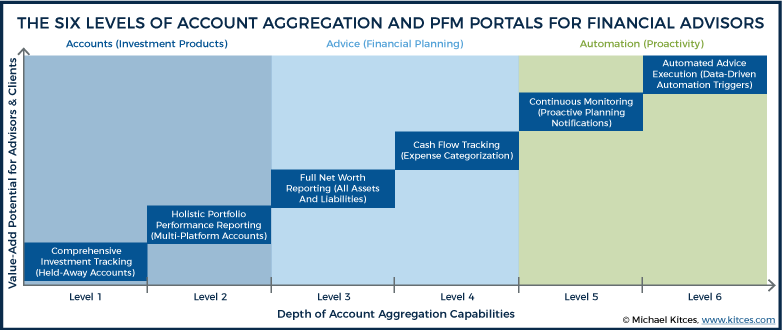
A couple of years ago, Michael Kitces, a well-known financial planning commentator, summarized the importance of data aggregation to the future of wealth management. His points are also valid for the family office.

This simple graphic summarizes a maturity model for data aggregation, along with the added value that can be achieved in each stage. It also demonstrates the importance of having the data needed for effective decision-making available in one place and normalized so that it is relational and bound by a data model that reflects the world of the family office.

Unfortunately, most wealth managers and family offices are only at Level 2 of this maturity model. Those forward-thinking family offices using a fully integrated technology platform, like AtlasFive, are at Level 4. They have the advantage of a single, unified data source, where both structured and unstructured data can be stored, queried, and reported on. This is a prerequisite for achieving Levels 5 and 6 in this diagram.

At these higher levels, the tools of Natural Language Generation (NLG), Artificial Intelligence (AI), and robotic data tools can be used to tremendous benefit. The goal of NLG, BOTS, or AI isn’t to replace employees. Instead, they enhance work tasks and allow staff members to add value where it really matters. They enable business processes to run with minimal (or no) effort from the team—to handle tasks automatically, send alerts, and trigger processes. The potential is there for these technologies to support and enhance businesses like a family office.

As the diagram indicates, mastering data aggregation will allow the family office to look forward. It means the office will finally have the data and tools to be proactive, to anticipate and service its family at a much higher level. This is when data aggregation has been reimagined at its highest level and when it can have the most significant impact on decision-making. It will be a key aspect of the family office of the future.

Direct Investing by Family Offices: The Barbell Challenge

The direct investing process for family offices is an ever-increasing “barbell” challenge. Initially there is the process of evaluation and due diligence around the proposed investment, and then once the investment is made the perils revolve around data and maintaining the investment “reality”: IRR, ownership, reporting, etc. Investment on one side and operations on the other — this can be a big-lift for a family office.

Family offices are often portrayed as ideal investors for investments like operating companies because they have a “patient capital” approach. Also, many families made their money by building and selling a successful company, so the focus on direct investments is often driven by families’ desire for a more direct role in the management of their investments in order to increase control and net returns. Such investments can also play a role as a shared experience, with older family members encouraging younger members to get involved in the type of business they are familiar with.

When an office pursues the direct investing route it needs expertise, whether internal or external, to manage sourcing deal flow, conducting due diligence, negotiating direct investments, analyzing market trends, understanding transaction documents, or providing management support.

Once a deal is finalized, the office needs expertise around performance tracking, expense tracking, the aggregation of data reported by the investment, maintaining partnership allocations, reporting of the investment at a family entity net worth level, etc.

In many family offices both sides of these “barbell” challenges are managed using spreadsheets, which is often a mistake. There is an argument that if the office is only managing one or two of these investments then a spreadsheet works fine.

In the last few years, data from organizations like FINTRX, Family Office Exchange, Campden Wealth, the Financial Times, and others have shown that this is not the case. A quote from a Barron’s article (2020) referencing the FINTRX report claims that “more than half of the approximate 3,500 to 5,000 family offices around the world invest directly today, according to the study, which draws on the firm’s database of more than 3,000 individual family offices globally and the 13,000-plus direct investment deals they have tracked.” This figure is probably on the low side, but even from this information, the average could be five direct investments in a family office and the industry sector could be anything, from service and manufacturing, to restaurants and sports teams.

The complexity on the operations side of the barbell depends on how the investment is structured, such as which entities managed by the family office invested and under what terms. Is it a loan that must be tracked, what percentage ownership, is there a flow-through to another entity like a trust, how will the investment company supply data like a balance sheet, when will they do it, how will it impact the reporting schedule the office has, and so on. These jobs are part of involved business processes and workflows needed by an office to produce a report like this example for a loan:

In this case, some of the data the office must track includes how the loans are being tracked and amortized, where the documentation regarding the loans is located, how the investment is being valued, whether this investment is reflected correctly at the trust beneficiaries’ level, etc.

There is a pattern forming on both sides of the barbell: the need for a best practice business process and workflow in dealing with the type and amount of information coming to the office when dealing with direct investments. The nature of the data and the manual processes involved call for a best practice approach, transparency, consistency, accuracy, efficiency, and effectiveness — and this is not easy using spreadsheets! The loan example above is a case in point, as it needs to be recorded, tracked, adjusted and reported on in an auditable system.

Very often people in a family office of “high value” are doing tasks they should not be doing but are forced to do them because of the importance of getting the task done right. What would the office gain if these people had an integrated tool that provided operational efficiency so that they could do real analysis around direct investments instead?

It would revolutionize the management and operation of single and multi-family offices when dealing with direct investments and beyond. To have a truly integrated platform, one that can facilitate the implementation of best practice business processes and workflows across multiple disciplines would solve challenges like having all the information for the loan example (documents PLUS accurate financial transaction information), in one place. It would be an enabler for planning and a strategic tool where the office has all the information to coordinate tasks and solve problems ahead of time.

A family office typically has great, dedicated, talented people, so if one single technology platform could provide the enterprise class processes, reporting, automation, and client delivery capabilities they need, then they could REALLY be in the business of managing the family’s affairs effectively, like direct investments. The end result is what the clients want: a highly engaged staff delivering excellent, timely reporting and service execution that is driven by automated, integrated best practices to provide best-in-class risk management.

How Proposed Changes with Bill H.R. 4620 May Affect Your Family Office

Since a single family office (SFO) is solely tasked with managing the money of one single family, the Securities Exchange Commission (SEC) has historically allowed them to operate under different regulations from traditional investment advisors. The 2008 financial crash first prompted regulators to reconsider this exemption. Although no changes were made at that time, the more recent collapse of Archegos Capital Management in March 2021 spurred lawmakers to introduce bill H.R. 4620, which would change how SFOs are regulated.

What does this new bill mean for your family office?

Until the bill passes and is enacted, the answer is: not much. But it’s never too early to be prepared for potential regulatory changes that could affect how your SFO operates.

Let’s start by looking at the parameters for registration that are presently in place.

Currently, SFOs are exempted from the requirement to register with the SEC as investment advisors, with a few exceptions. Certain factors, such as how the office is structured or how it invests, might result in the SFO breaching defined limits and requiring registration with authorities.

Because SFOs are used by wealthy families to achieve wealth preservation, they are often referred to as “patient capital,” with a long-term view and an asset and risk mix supporting this. Sayings like “Shirtsleeves to shirtsleeves in three generations” and “Wealth does not last beyond three generations” are well-known for a reason. A wealth consultancy, The Williams Group, conducted a 20-year study involving several thousand families and found that seven in 10 families tend to lose their fortune by the second generation, while 9 in 10 lose it by the third generation.

Despite these dismal numbers, the fate of Archegos Capital brought the family office market to broader notice, and worldwide, the media claimed amounts in the range of 5 to 7 trillion dollars were being managed by these family offices. Without context, these numbers give the impression that SFOs are too large to be unregulated. However, this macro view needs to be tempered by examining how and where typical family offices invest. The “patient capital” approach taken by many SFOs is often quite different from the investment approach taken by traditional investors.

What changes if bill H.R. 4620 passes?

Bill H.R. 4620 will amend the Investment Advisers Act of 1940 to impose regulatory oversight of family offices. Critically, the bill would limit the exemption from registration to only “covered” family offices, which refers to those with less than $750 million in assets under management (AUM). If the office has more than $750 million in AUM, it would be required to register with the SEC as an investment advisor and follow investment advisor regulations and reporting rules.

The AUM is not the only criteria in the new bill. A reporting requirement can also be determined by the “high risk” of any investments. It would also require that all family offices provide “such annual or other reports as the Commission determines necessary or appropriate in the public interest for the protection of investors.”

A single family office manages the money of one single family. The office is tasked with acting in a fiduciary manner for the benefit of the whole family, and it is not part of a for-profit industry sector like banks or hedge funds. Rather than regulation, perhaps there is a case for more professionalism — an opportunity to move away from the “cottage industry” approach and operate with structure and standards that meet, if not exceed, those of a regulated business.

To achieve this, the family office staff need the right tools; the days of running the office with spreadsheets and a simple accounting software product are gone. A modern family office needs an integrated technology approach, with a single data source, as the foundation for professional operations. This professionalization would do more than regulation to meet the fiduciary needs of a modern wealthy family.