The Hidden Costs of Fragmented Wealth Management Systems
Most family offices operate with a familiar set of tools:
A portfolio reporting platform.
An accounting system.
A CRM.
Custodian portals.
Document storage systems.
Spreadsheets fill the gaps between them.
Individually, each tool performs its role. Collectively, they create fragmented wealth management. And that friction carries hidden costs.
Fragmentation Is the Norm
Few family offices built their technology infrastructure all at once. Systems are usually added over time:
a reporting system for investments
An accounting platform for reconciliation
separate tools for document management
external providers for tax and trust services
The result is an environment where information exists in silos. Teams spend a large portion of their time not analyzing wealth, but locating it. This lack of integrated wealth tech is a silent productivity killer.
The Operational Tax
Fragmentation creates what many professionals quietly refer to as the operational tax family office teams must pay daily.
It appears in small ways:
downloading data from multiple systems
reconciling discrepancies between platforms
validating information manually
moving documents between teams
Rebuilding reports from different sources
None of these tasks generates strategic value. Yet they consume significant time when reconciling financial systems manually.
Why AI Changes the Equation
Artificial intelligence does not simply automate tasks. It changes how systems interact.
Instead of professionals moving between platforms to gather information, AI for portfolio reporting can pull data from multiple sources and synthesize it into a unified view. The shift is subtle but powerful.
Instead of systems dictating workflow, the workflow becomes conversational and outcome-driven.
Professionals can ask questions such as:
“Show my portfolio exposure to private credit.”
“Validate this capital call.”
“Reconcile this account.”
And the system handles the underlying complexity.
Unlocking Document Intelligence
Another major source of fragmentation is documentation. Capital calls, K-1s, partnership agreements, custodian statements, and invoices often hold the most important information within the family office.
Historically, this information has been trapped in PDFs.
Document intelligence now allows these documents to be converted into structured data and integrated into the same intelligence layer as transactions and accounting records. This unlocks insight that was previously inaccessible.
From Fragmentation to Intelligence
The long-term solution to fragmented systems is not adding more software. It is creating a unified data foundation.
When data from investments, accounting, tax structures, and relationships sits within a unified architecture, AI can begin identifying patterns and generating insights. This allows family offices to shift from reactive reporting to proactive intelligence.
The Real Advantage
Technology fragmentation slows decision-making. Integrated intelligence accelerates it.
For family offices managing complex portfolios across multiple asset classes, this advantage becomes increasingly important.
AI does not replace existing systems. But it connects them and makes them significantly more powerful.
How EtonAI™ Solves This Challenge
EtonAI™directly addresses the hidden costs of fragmented wealth management systems by creating a true unified data foundation. It moves beyond simply automating tasks by leveraging its unique hybrid AI architecture, including pre-trained LLMs, RAG, a patent-pending Knowledge Graph, and a Vector Database. This allows EtonAI™ to pull data from AtlasFive®, external web sources, and over 250 document types via its Intelligent Document Processing Agent. It transforms siloed information into structured intelligence, enabling seamless data flow and a unified view that eliminates the “operational tax.” Whether as a seamless extension of AtlasFive® or a standalone platform, EtonAI™acts as the connective tissue, making your disparate systems significantly more powerful.
Ready to transform your family office operations with intelligent automation?
Family office AI discussions are happening more than ever before. Investment committees debate it. Next-generation family members champion it. CIOs explore potential use cases.
And yet, in many organizations, AI adoption in wealth management isn’t translating into meaningful capital allocation or operational change.
Why? Because the conversation about AI often happens at the strategic level, while the barriers are operational.
The Gap Between Curiosity and Implementation
In many family offices, AI for family offices initiatives stall because they begin with broad ideas instead of practical AI workflows.
The discussion starts with questions like:
“How should we invest in AI?”
“What will AI mean for wealth management?”
“Should we build an AI strategy?”
Those are valid questions. But they often skip the most important one: Where will AI actually improve the daily work of the family office? In reality, operational AI rarely begins with a strategic vision. It begins with solving operational friction.
The Real Starting Point: Workflows
Family offices operate in complex environments. Data sits across custodians, administrators, reporting platforms, CRM systems, and spreadsheets.
Documents—capital calls, K-1s, partnership agreements, invoices—often contain the majority of the information teams need to manage wealth.
In fact, most organizations discover that nearly 80% of their usable data sits in documents, not databases. This is where document intelligence begins to unlock value.
Instead of manually extracting information from documents, validating transactions, and reconciling data across systems, AI in private wealth contexts can automate these tasks and transform them into structured intelligence.
The result is not simply faster processing. It is a better decision infrastructure.
Why Capital Allocation Follows Capability
Family offices allocate capital toward areas where they have conviction and operational readiness. AI follows the same rule.
When a family office sees AI-driven reconciliation improve:
document processing
reconciliation
portfolio queries
reporting workflows
The technology moves from experimentation to strategic priority. This is why the most successful AI initiatives in wealth management start with practical use cases rather than abstract strategy.
AI as an Operational Multiplier
Another misconception is that AI primarily affects investment decisions. In reality, its first impact is operational.
AI helps family offices:
Extract data from documents automatically
Verify transactions and vendors
Accelerate accounting workflows
Generate portfolio insights quickly
Reduce manual administrative tasks
Over time, these improvements compound. Teams gain time. Data becomes cleaner. Decisions become more informed. Only then does AI begin influencing higher-level strategic decisions.
The Real Shift: From Tool to Outcome
Traditional wealth platforms require users to navigate systems step by step. Family office AI changes that dynamic.
Instead of searching through multiple screens, professionals can simply ask questions and receive validated answers—for example:
portfolio risk summaries
capital call validation
net worth insights
transaction confirmations
The system moves from a navigation model to an outcome model. This change might sound small, but operationally it is significant. It reduces friction across the entire organization.
What AI Adoption Actually Looks Like
In practice, family offices that successfully adopt AI tend to follow three stages:
Stage 1: Operational automation
Document processing, reconciliation, and reporting.
Scenario modeling, predictive analytics, and family reporting.
Each stage builds confidence in the technology. And confidence leads to allocation.
Moving From Interest to Implementation
For family offices, the AI conversation should not begin with abstract transformation. It should begin with one simple question: Where is the friction in your daily operations?
Solve that problem first. Once teams experience tangible improvements through specific AI workflows, AI quickly becomes less of a concept and more of a capability.
How EtonAI™ Solves This Challenge
EtonAI™by Eton Solutions is purpose-built to bridge the gap between AI ambition and practical implementation. Its intelligent automation starts with solving those critical operational frictions. EtonAI™’s Autonomous Agents are designed to tackle repetitive middle and back-office tasks, from processing complex documents across 250+ types to automating reconciliation and reporting. This practical application of operational AI demonstrates immediate value, building the confidence needed to drive capital allocation and transition from strategic talk to real-world deployment. By delivering up to 90% improvements in speed, accuracy, and efficiency across core wealth management processes, EtonAI™ makes the case for AI investment undeniable.Ready to transform your family office operations with intelligent automation?
In sophisticated wealth environments such as family offices, ultra-high-net-worth structures, and multi-entity portfolios, client accounting is far more than bookkeeping.
It is the operational backbone that enables transparency, governance, and confidence in financial decision-making.
Every investment, entity structure, distribution, and expense ultimately flows through accounting systems. When those systems are fragmented or manual, the consequences ripple throughout the organisation, delayed reporting, reconciliation challenges, compliance risk, and limited visibility for principals and executives.
As wealth structures grow more complex and global, modern client accounting platforms must evolve beyond spreadsheets and disconnected tools.
This is where platforms such as AtlasFive® by Eton Solutions are redefining what client accounting can deliver.
Why Client Accounting Has Become a Strategic Priority
Family offices and wealth management organisations are operating at an increasingly institutional level.
Portfolios span multiple jurisdictions, asset classes, custodians, and legal entities. Private investments introduce capital calls, partnership allocations, and valuation complexity. Governance expectations from principals and regulators continue to rise.
In this environment, client accounting is the single source of operational truth.
When accounting infrastructure is strong, organisations gain:
Accurate and consolidated financial reporting
Clear visibility into cash flow and performance
Reliable governance and audit trails
Confidence in tax, compliance, and regulatory processes
However, many organisations still rely on fragmented systems that were never designed for the complexity they now manage.
Spreadsheets and traditional accounting tools struggle to keep pace with multi-entity structures, cross-border investments, and increasing reporting expectations.
The result is operational friction that consumes time, introduces risk, and delays insight.
AtlasFive®: Client Accounting Built for Modern Wealth Operations
AtlasFive® was designed specifically to support the operational needs of family offices, wealth managers, and complex investment structures.
Recognised as the Client Accounting Winner at the WealthBriefing WealthTech Americas Awards 2026, AtlasFive® provides a fully integrated accounting environment capable of managing the complexity modern wealth organisations face.
Rather than treating accounting as a standalone function, AtlasFive® integrates it into a unified operating platform where financial data, investments, and governance workflows coexist in one secure environment.
The result is greater clarity, stronger controls, and significantly reduced operational friction.
A Single Source of Truth Across Ledgers
One of the most persistent challenges in wealth operations is fragmented financial data.
AtlasFive® addresses this through a unified accounting architecture that consolidates multiple ledgers into a single platform:
General Ledger (GL)
Investment Book of Record (IBOR)
Capital Book of Record (CBOR)
This structure ensures that transactions, investment activity, and capital allocations are synchronised and reconciled across the organisation.
By maintaining a single, authoritative source of financial truth, AtlasFive® enables accurate reporting, improved oversight, and audit-ready financial records.
Automating Reconciliation Across Accounts and Entities
Manual reconciliation remains one of the most time-consuming processes in wealth operations.
Transactions must be gathered from banks, custodians, and portfolio systems before being matched, coded, and verified. When handled manually, this process introduces delays and increases the risk of errors.
AtlasFive® automates reconciliation workflows by aggregating transaction data, applying accounting rules, and matching entries across accounts and entities.
This automation significantly reduces manual work while ensuring that financial data remains accurate and up-to-date.
Operational teams can then focus on oversight and analysis rather than repetitive administrative tasks.
Managing Multi-Entity and Multi-Currency Complexity
Family offices frequently manage dozens, or even hundreds, of entities spanning multiple jurisdictions.
These structures introduce additional complexity around currency management, reporting standards, and transaction flows.
AtlasFive® provides native support for multi-entity and multi-currency accounting, allowing organisations to manage complex financial structures within a single platform while maintaining consistent reporting and transparency.
This capability is particularly valuable for global portfolios where assets, investments, and expenses are distributed across multiple countries and regulatory environments.
Real-Time Reporting for Decision-Makers
Executives, principals, and family office stakeholders increasingly expect real-time insight into financial positions and performance.
AtlasFive® enables this through dynamic dashboards and reporting tools that provide visibility into:
Financial position
Cash flow
Investment performance
Entity-level activity
Client statements, operational dashboards, and governance reports can be generated quickly, providing decision-makers with timely and reliable insight.
Built for Governance and Audit Readiness
In regulated environments, transparency and accountability are essential.
AtlasFive® includes built-in governance capabilities such as:
Transaction audit trails
Approval workflows
Change history tracking
Compliance-ready reporting
These controls help organisations maintain strong governance while simplifying external audit processes.
Rather than reconstructing financial activity after the fact, organisations can rely on a continuously maintained audit trail.
From Data Intake to Insightful Execution
Modern client accounting platforms must manage the entire lifecycle of financial data.
AtlasFive® follows a structured workflow that transforms raw data into actionable insight:
Centralise Data Transactions and balances are automatically gathered from banks, custodians, and external systems.
Automate Reconciliation The platform reconciles, validates, and codes transactions while flagging exceptions.
Generate Insightful Reporting Client statements, consolidated financials, and performance dashboards are produced with speed and accuracy.
Maintain Governance and Audit Trails Full transparency is maintained through detailed logs, version histories, and approval controls.
The Future of Client Accounting
As wealth structures continue to grow in complexity, client accounting will become even more central to operational success.
Leading organisations are moving away from fragmented tools toward integrated platforms that combine accounting, investment oversight, and governance in a single environment.
By modernising client accounting infrastructure, family offices and wealth managers gain the clarity and operational resilience required to manage wealth across generations.
Experience Modern Client Accounting
Discover how AtlasFive® helps wealth organisations automate reconciliation, unify financial data, and gain real-time visibility across complex structures.
Family offices have evolved far beyond their traditional role of managing wealth. Today, they operate as sophisticated enterprises responsible for investment strategy, governance, reporting, accounting, and long-term legacy planning.
The 2026 Global Family Office Report (Global Family Office Report 2026, J.P. Morgan Private Bank), based on insights from more than 300 family offices worldwide, highlights how these organisations are adapting to a rapidly changing landscape.
From artificial intelligence to rising operational complexity, the report reveals several powerful trends reshaping how family offices operate, and why the right technology platform has become essential.
Solutions like Eton Solutions’ AtlasFive® platform and EtonAI™ intelligence layer are designed specifically to address these challenges, enabling family offices to transform operational complexity into clarity and control.
Family Offices Are Becoming More Complex Organisations
Over the past decade, family offices have expanded in size, capability, and global reach. Many now oversee investments across industries, geographies, and generations, making them more comparable to institutional investment organisations than private administrative offices.
Managing multi-entity structures, private investments, trusts, partnerships, and cross-border assets requires operational infrastructure that many family offices are still building.
This is where integrated platforms such as AtlasFive® become critical.
AtlasFive® acts as the operating system for family offices, bringing together:
• Investment accounting • Partnership and entity accounting • General ledger and reporting • Document management and workflows • Aggregated portfolio reporting
By consolidating operations onto a single platform, family offices gain a single source of truth across their entire wealth ecosystem, eliminating fragmented systems and manual reconciliation processes.
AI Is a Priority. But Implementation Is Lagging.
Artificial intelligence has quickly become one of the most discussed opportunities in family office operations.
The report shows that 65% of family offices plan to prioritise AI, yet many struggle to move beyond experimentation. (Global Family Office Report 2026, J.P. Morgan Private Bank).
The challenge is not interest, it is infrastructure.
AI requires structured, reliable data and integrated operational systems to function effectively. Many family offices still rely on fragmented software tools or manual processes, limiting their ability to apply AI in meaningful ways.
Eton Solutions addresses this gap through Eton GPT™, an AI companion built directly on top of the AtlasFive® platform.
Eton GPT™ enables family offices to:
• Automate document extraction from capital calls, distribution notices, and tax documents • Assist with operational tasks through conversational AI and voice commands • Analyse investment and operational data in real time • Support workflow automation across accounting, reporting, and operations
By embedding AI into the operational system itself, Eton Solutions allows family offices to move from AI ambition to practical implementation.
Rising Costs Are Forcing Operational Change
Operating a family office is becoming increasingly expensive.
According to the report, the average annual operating cost for a $1 billion family office is $6.6 million, driven largely by talent competition and the need for specialised expertise. (Global Family Office Report 2026, J.P. Morgan Private Bank).
Technology and automation are becoming critical tools for controlling these costs.
Platforms like AtlasFive® help family offices:
• Automate reconciliations and accounting workflows • Reduce manual data entry and reporting processes • Improve operational efficiency without increasing headcount • Scale operations as assets grow
In many cases, automation can reduce hours of manual operational work to minutes, allowing teams to focus on strategic oversight rather than administrative tasks.
Private Investments Continue to Gain Momentum
Private markets remain one of the most important areas of focus for family offices.
Many organisations are increasing allocations to private equity, venture capital, private credit, and real estate, seeking diversification and long-term growth.
However, private investments introduce significant operational complexity.
Capital calls, distributions, fund reporting, valuations, and partnership allocations require sophisticated tracking and accounting processes.
AtlasFive® was designed specifically to manage these complexities, offering:
• Automated capital call and distribution tracking • Partnership accounting and allocations • Private investment reporting and valuations • Integrated document management for fund communications
This allows family offices to manage private market exposure with institutional-grade operational control.
Governance and Legacy Are Becoming Strategic Priorities
Beyond investment performance, family offices are increasingly focused on governance, succession, and long-term continuity.
The report highlights that 57% of family offices prioritise preserving family values, governance, and legacy, yet many organisations still lack formal succession plans for leadership roles. (Global Family Office Report 2026, J.P. Morgan Private Bank).
Technology plays an important role in strengthening governance.
Platforms like AtlasFive® provide:
• Complete audit trails for financial activity • Structured workflows for approvals and governance • Secure document storage for legal and fiduciary records • Consolidated reporting for stakeholders and family members
These capabilities help family offices maintain transparency, accountability, and continuity across generations.
Technology Is Becoming the Foundation of the Family Office
One of the clearest conclusions from the report is the growing demand for integrated technology platforms. (Global Family Office Report 2026, J.P. Morgan Private Bank).
Family offices increasingly require:
• Aggregated reporting across institutions • Real-time visibility into assets and investments • Integrated accounting and operational infrastructure • Strong cybersecurity and data governance
Eton Solutions was built specifically to deliver this foundation.
Through AtlasFive®, EtonAI™, and EtonAlpha™, the platform provides an end-to-end operating environment that unifies:
This allows family offices to move away from fragmented tools and toward a fully integrated digital operating model.
未来的家族办公室
The next generation of family offices will look very different from those of the past.
They will operate with:
• Institutional-grade investment infrastructure • AI-enabled operational intelligence • Integrated accounting and reporting systems • Strong governance frameworks • Real-time visibility into global wealth structures
As complexity continues to grow, the ability to unify operations, data, and reporting will become one of the defining advantages of leading family offices.
Platforms like AtlasFive® 和 EtonAI™ enable family offices to transform complexity into clarity, helping them manage risk, control costs, and support future generations.
Ready to simplify your family office operations?
Discover how AtlasFive®, EtonAI™, and EtonAlpha™ help family offices unify data, automate operations, and gain real-time visibility across complex wealth structures.
1. Tell us about yourself and your role at Eton Solutions.
I’m the Chief Information Officer at Eton Solutions, and I’ve been working in AI for about 40 years. To be honest, about 36 of those years were what we call the AI winters—lots of promise but very little real-world adoption. The advantage of living through those cycles is that you learn what actually works in enterprise environments and what doesn’t. Today we’re finally at the point where AI can move from experimentation to operational impact.
2. Tell us about Eton Solutions and its offering in this space.
Wealth management historically lacked a true enterprise operating platform. Eton Solutions was founded in 2015 with a clear mission: to build the ERP for wealth management. Today, a decade later, we manage over $1.4 trillion in assets on platform, covering investment accounting, partnership accounting, tax, and trust — the full operational backbone of a modern family office.
At the core is AtlasFive®, our System of Record. That’s critical because in wealth management, trust and auditability are non-negotiable. AtlasFive®provides the single source of fiduciary-grade truth — deterministic, governed, and reliable.
In 2020, we introduced AI through machine learning and expert systems. In early 2023, we expanded into generative AI with Eton GPT™. But we didn’t just add AI — we built a System of Action that focuses on delivering business outcomes. If AtlasFive® is the institutional memory, EtonAI™ is the operational brain. It turns trusted data into decisions, workflows, and insight. AI without a system of record is guesswork. Anchored to fiduciary data, it becomes transformative.
That’s the journey: from system of record to intelligent system of action — and now toward an AI-native operating model.
3. What types of clients do you work with and target?
We started with family offices, which remain our core segment. As the platform matured, we expanded to adjacent segments that face similar operational complexity—wealth owners, business managers, trust companies, and private equity firms. We’ve grown so we can handle clients from $25 million to multi-billion-dollar family enterprises.
4. What components make up the EtonAI™ solution?
EtonAI™ is anchored by two core components: the Co-Pilot and Agentic automation. The Co-Pilot is the conversational interface—users simply ask it to execute tasks, whether that’s updating a beneficiary or running a query. It interprets, acts in AtlasFive®or connected systems, and returns results—streamlining human decision- making.
The Agentic layer is a suite of autonomous agents. They handle repeatable workflows—retrieving fund documents, classifying transactions, and routing them downstream—operating independently but within strict governance. Together, the Co-Pilot enables guided action; the agents deliver scalable execution.
The key shift is that AI is no longer just an interface — it is becoming an execution layer that can complete operational work across systems.
5. What problems were you trying to solve when you founded EtonAI™?
AtlasFive® is a powerful system of record — it processes investment, accounting, tax, and trust data with fiduciary precision. But even the best system of record doesn’t complete the work. It stores truth; it doesn’t reason.
EtonAI™ was built to close that gap. It is an AI reasoning and decisioning engine layered on top of AtlasFive®that doesn’t just surface data — it executes workflows and delivers outcomes. Reconciliations, allocations, validations, approvals — the operational heavy lifting.
For clients, this is critical because scale in wealth management doesn’t break at the ledger — it breaks in the human bottleneck. Month-end close, capital call processing, transaction validation — these are judgement-heavy, repetitive processes that consume hundreds of hours and create operational risk.
That’s where our Maker–Checker–Learner model becomes strategic.
The AI acts as the Maker — drafting, classifying, preparing. The human remains the Checker — providing fiduciary oversight and approval. And the Learner captures every correction and edge case, reinforcing it back into the system.
Over time, the platform adapts. It gets smarter with each exception, each allocation nuance, each entity structure. That means fewer repeat errors, less rework, and compounding efficiency gains.
This model mirrors the governance structures that already exist in financial institutions — separation of duties, review, and continuous learning.
For customers, this isn’t just automation. It’s adaptive operational intelligence — scale without sacrificing governance.
6. What are the key characteristics and benefits of EtonAI™?
First: productivity. We typically deliver a 30% improvement at minimum, and in some workflows — like approvals or document processing — we’ve seen 8x gains. Tasks that took two hours now take five minutes. Month-end close and mark-to-market are prime examples. The point isn’t incremental efficiency — it’s step-change acceleration. AI changes the economics of operations. Work that previously required teams can now be executed as intelligent workflows.
Second: decision quality. EtonAI™ doesn’t just speed up approvals; it enriches them. A capital call decision, for example, can be evaluated against commitments, historical allocations, fund performance, liquidity positions, and contractual terms — instantly. Instead of acting on one or two data points, clients act on full-context intelligence. Faster decisions — and better ones.
Third: expansion of capability. We call it eliminating the “embarrassment tax.” AI gives teams the ability to interrogate tax filings, partnership structures, or performance drivers before speaking to external advisers. You’re not replacing experts — you’re showing up to the conversation informed. That elevates the quality of governance across the organization.
So the impact is clear: More output. Better judgement. Broader capability. All without adding headcount.
7. What key lesson have you learned from your deployments in AI in recent years?
The key lesson is that enterprise AI deals in probabilities, not absolutes. If the AI is 85% correct, that’s powerful—but only if you know exactly which 15% needs human correction. The process must be built so that every decision point is transparent and auditable—you know what the AI got right, and exactly where a human steps in.
That’s why enterprise AI isn’t like a B2C chatbot. Chatbots offer answers, but enterprise AI must deliver governed outcomes. EtonAI™ was built for B2B: every step is explainable, auditable, and scalable. We learned that success comes from combining AI’s speed with human judgement at the right moments. In short: AI doesn’t replace governance—it makes it scalable and smarter every step of the way.
Enterprise AI is not about perfect answers — it’s about governed outcomes.
8. What’s next on the roadmap for Eton Solutions?
We are currently rolling out EtonAI 2.0, which focuses on delivering a much broader range of completed operational outcomes, not just assisting with individual tasks. The industry is moving from systems that record activity to systems that complete work autonomously.
Historically, our AI capabilities were concentrated within AtlasFive®, helping automate activities such as document processing, data extraction, and transaction handling. The next phase expands this capability so that EtonAI™ can coordinate work across the different systems family offices rely on — investment platforms, CRM systems, document repositories, and external data sources.
The goal is to move from AI that helps people do tasks to AI that completes entire operational jobs. For example, preparing daily data updates, assembling reports, reconciling transactions, organizing documents, or supporting the month-end close process.
As we increase the number of these automated outcomes, operations teams spend less time on manual coordination and exception handling. Instead, they can focus on oversight, decision-making, and governance — ensuring accuracy, reviewing exceptions, and managing the increasingly complex financial environments that family offices operate in.
In short, the roadmap is about delivering more operational outcomes through AI, while enabling people to concentrate on higher-level activities that require judgment, control, and accountability.
9. What trends do you see shaping the wealth management sector and how is Eton Solutions supporting them?
For decades, competitive advantage in wealth management came from owning proprietary data. Today, most firms have access to similar data sources. The real value has shifted to the ability to orchestrate that data using AI, particularly in a world that is becoming more politically and economically fragmented, where resilience is increasingly augmenting—and in some cases replacing—pure efficiency as the operating priority.
One of the most important shifts is the move from simple AI assistants to agentic AI operating models. Earlier systems summarized information; today AI can coordinate and complete multi-step operational workflows—such as data aggregation, reconciliation, reporting, and document processing. At Eton Solutions, EtonAI™ acts as an operational intelligence layer, completing work across the family office rather than simply assisting with individual tasks.
Another major trend is the emergence of a “unified client brain.” Wealth managers are building consolidated views of clients across investments, entities, documents, and life events to deliver personalized service at scale. AtlasFive® combined with EtonAI™ brings operational data, documents, and workflows into a unified environment where intelligence can be applied consistently across the entire client relationship.
At the same time, AI is not replacing advisors—it is amplifying them. By automating a significant portion of administrative work, often 30–40 percent of operational activity, AI allows professionals to focus on governance, strategic decisions, and client relationships, particularly in complex multi-generational families.
Overlaying all of this is a more complex global political and regulatory environment, with cross-border tax regimes, geopolitical fragmentation, and divergent rules around AI and digital assets. As wealth becomes more mobile, firms need systems that can manage complexity while maintaining transparency and compliance.
This is where AtlasFive®and EtonAI™ come together: AtlasFive® provides the operational system of record, while EtonAI™ provides the intelligence layer that helps manage workflows and decisions across that environment.
Ultimately, success in modern wealth management will be defined less by who owns the most data and more by who can manage complexity with the greatest transparency and trust.
Let’s start with a question we hear all the time: why do we say that ‘data is the fuel for AI’?
To answer that, it helps to look at how AI is different from traditional software.
Traditional software is powerful but it’s still just a tool, and it starts out empty. You have to feed it. You pull data from filing cabinets, spreadsheets, or legacy systems, and you do all the work inputting, structuring, maintaining. If you’re using something like Word, it’s still all on you you’re the one writing, creating, inputting.
AI completely flips that model. It doesn’t start empty — it begins pre-loaded with knowledge drawn from a vast expanse of data, language, and experience from the internet. You don’t have to upload a database before you can talk to it; you simply ask a question, and it can already reason, infer, and decide. It can draw from the world’s collective information, synthesize it.
And when you give it your data, it doesn’t just store it—it starts to reason, generate, and adapt. That’s the shift: from just programming tools to building systems that can actually help you make decisions, spot patterns, and even write the first draft.”
And here’s a true story to prove the point. One of the very first things I did with ChatGPT was ask it to write a love letter to my wife. I decided to test it — Rumi-style mysticism, Kahlil Gibran’s philosophy, even Wordsworth’s walk-in-the-woods poetry and Mark Twain’s humor.
The result? Absolute perfection. So perfect, in fact, that I handed it to my wife with a smug smile… and she read it for about three seconds before saying:
“You didn’t write this,”
I confessed. She laughed. And for a moment, I had the unsettling realization that AI had finally done the impossible — it made my wife fall in love… just not with me.
The Real Lesson
AI can mimic brilliance. It can channel Rumi, quote Aristotle, and sound like Mark Twain on a good day.
But what it cannot do — on its own — is sound like you. Not without context. Not without your tone, your stories, your preferences, your history.
Your data.
That’s the real breakthrough: AI becomes powerful not when it knows everything, but when it knows you.
Your data is the map. Your context is the compass.
Together, they transform AI from a clever machine into a genuine collaborator — one that amplifies your thinking, accelerates your work, and occasionally writes a love letter better than you ever could.
In business, the same rule applies: the quality of the outcome depends not on how powerful the model is, but on how rich, organized, and contextual your data is.
That’s exactly what we built EtonAI to do — to make your data AI-ready and context- aware so it can fuel true wealth intelligence for the modern family office. When the system understands the structure, lineage, and meaning behind your information, the intelligence becomes specific, relevant, and capable of supporting real fiduciary decisions — not just generating clever text.
This is the shift the world is living through: from software you have to feed… to systems that learn you.
Yes, ChatGPT may have outperformed me as a poet that day — but it was my data that gave it meaning.
A Few Samples From the “Competition”
Rumi-style mysticism: “My love, you are the soul’s eternal flame, a mystic dance in the garden of my heart. Like a whirling dervish, your presence spins me into realms beyond words.”
Aristotle’s logic: “In the geometry of life, my dear, you are the axiom that makes all proofs of love consistent.”
Gibran-style philosophy: “You are not just my beloved; you are the thought that awakens the sleeping spirit within me.”
Wordsworth’s walk-in-the-woods poetry: “You are the wildflower that blooms in the meadows of my heart, bringing beauty to every ordinary day.”
My actual letter, from my heart no EtonAI, no ChatGPT: “Somewhere along the way, my heart stopped being mine. You didn’t steal it — it just recognized where it was meant to be. Now that you’re holding it, the world looks different: lighter, warmer, more alive. You’ve become the quiet reason behind everything I do.”
About the Author
Murali Nadarajah is a technology and AI pioneer with 30+ years of experience building intelligent platforms across global industries. At Eton Solutions, he leads the company’s shift toward AI-native wealth management—combining LLMs, agentic automation, and enterprise-grade security. His career reflects a lifelong passion for AI and building systems that elevate human judgment through intelligent automation.
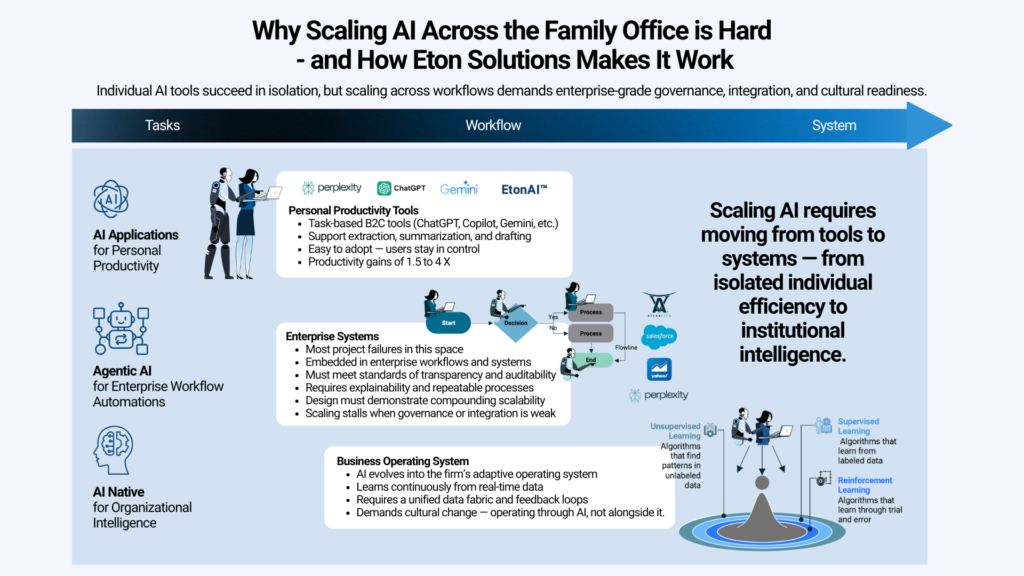
Most companies don’t struggle with using AI, they struggle with scaling it.
Teams adopt ChatGPT, Gemini, Perplexity, Copilot, or even EtonAI for personal productivity. They see quick wins: faster drafting, cleaner summaries, smoother research.
But the moment an organization tries to push AI past individual tasks, into workflows, systems, approvals, reporting, 或 decision-making, everything breaks.
This is the AI Scaling Gap, and it’s where most enterprise AI programs stall.
At Eton Solutions, we’ve spent years engineering an architecture that closes this gap, helping firms evolve from isolated tools to a truly AI-native operating model.
Why AI Breaks When You Try to Scale It
AI adoption usually starts at the task layer, where assistants boost individual productivity by 1.5× to 4×.
The problem? These tools sit outside the systems that actually run the business. They don’t touch accounting, documents, approvals, compliance, or reporting, so organizational behavior never changes.
The moment you try to move AI from isolated tasks into real workflows, the challenges multiply:
Transparency must be guaranteed
Decision logic must be auditable
Outputs must comply with regulations
Actions must integrate into downstream systems
Most AI tools can’t meet these standards. EtonAI can.
The Workflow Layer: Where Most AI Projects Fail
True transformation starts when AI operates inside business processes, not alongside them.
But workflow AI must understand:
The meaning of documents
The context of transactions
The rules meant to govern decisions
The downstream impact of its actions
EtonAI’s agent architecture is engineered for this world. It can:
Interpret documents
Apply rules and policies
Trigger workflow actions
Reconcile and validate data
Record its reasoning for audit trails
This is where automation becomes reliable, explainable, and scalable.
The Highest Level: AI as Part of the Operating System
Once AI is embedded inside the enterprise core, AtlasFive®, it becomes a learning, continuously improving intelligence layer for the organization.
This is where the real strategic advantage emerges:
Continuous learning across systems
Pattern recognition for anomalies and opportunities
Predictive insights across financial operations
Automated processes that get faster over time
Executive decision support with real-time context
This is no longer “AI assistance.” This is institutional intelligence.
How Eton Solutions Makes AI Scalable
EtonAI integrates across the three layers in a way no stand-alone tool can:
1. Tasks → Workflows
Agents connect personal productivity tools to integrated workflow steps with compliance and audit trails.
2. Workflows → Systems
AI becomes embedded inside AtlasFive®, the accounting, reporting, and entity management core, guaranteeing data integrity and explainability.
3. Systems → Institutional Intelligence
Unified data + AI feedback loops = an operating model that learns, adapts, and compounds value across the enterprise.
This is how AI stops being fragmented and becomes a competitive engine.
Why This Matters
Most enterprises deploy AI as a patchwork of tools. They get fragmented efficiency—but not transformation.
Eton Solutions takes a different view:
AI is not a feature. AI is an operating model.
By scaling AI from tasks → workflows → systems → institutional intelligence, firms finally achieve what AI has promised for years:
Compounding, enterprise-wide value. Clarity. Control. And a unified, intelligent organization.
This is the future of enterprise AI. And this is what Eton Solutions delivers.
Experience Institutional Intelligence for Yourself
If you’re ready to see how EtonAI and AtlasFive® transform scattered tools into a fully integrated AI operating model, book a demo today.
In April 2025, Eton Solutions achieved ISO/IEC 42001:2023 certification following a rigorous independent audit of our Artificial Intelligence Management System (EtonAI™). This milestone confirms that our AI governance, controls, and management practices meet recognized international standards for responsible AI development and deployment. It reflects our unwavering commitment to responsible AI principles—including transparency, explainability, auditability, and continuous improvement—reinforcing our position as a leader in AI-driven wealth management solutions.
What is ISO/IEC 42001:2023
ISO/IEC 42001:2023, officially known as the “Artificial Intelligence Management System” (AIMS), is the world’s first global standard designed specifically for AI systems. It establishes a comprehensive framework that integrates responsible AI governance, risk mitigation, transparency, and regulatory compliance into an organization’s operational DNA. Certification signals that an independent, accredited body has verified our AI governance processes as robust, trustworthy, and aligned with international best practices. This milestone sets a new standard for AI management, emphasizing responsible AI governance.
Why This Certification Is Crucial for Our Clients
This achievement isn’t merely a badge of honor; it delivers tangible operational and compliance benefits to our clients and partners, transforming how they assess and engage with wealthtech providers like Eton Solutions:
Faster Due Diligence and Vendor Risk Management: Certified compliance with ISO 42001 streamlines the assessment process for new vendors, reducing onboarding times. Clients gain confidence in Eton Solutions’ commitment to AI governance, simplifying procurement cycles and reducing potential legal or regulatory concerns.
Documented AI Governance & Auditability: Our certification confirms that our AI systems are governed by well-documented policies, controls, and risk mitigation strategies. This enhances transparency and provides clients with structured audit trails, facilitating regulatory reviews and internal assessments.
Alignment with Global Standards on Privacy, Security, and Compliance: Our workflows within EtonAI and AtlasFive consistently adhere to international standards, ensuring that client data, privacy, and security are managed responsibly and securely across all operations.
Enhanced Trust and Reputation: Achieving ISO 42001 demonstrates that Eton Solutions prioritizes responsible AI governance, fostering increased trust among clients, investors, and regulators. It positions us as a credible leader committed to responsible AI deployment in wealthtech.
What It Means for the Future
The adoption of ISO 42001 by organizations across various industries signals a broader shift towards responsible AI management. Eton Solutions’ certification positions us at the forefront of this movement, enabling us to:
Continue innovating while maintaining the highest responsible AI standards.
Provide clients with safer, more transparent AI-driven solutions.
Lead by example in the evolving landscape of AI regulation and governance.
This movement is reflected across industries, from tech giants to financial service providers—who recognize that responsible AI isn’t just a regulatory requirement but a core value for sustainable growth.
Our Commitment Going Forward
At Eton Solutions, we believe that responsible AI governance is critical to building long-term client partnerships and industry trust. Our ISO/IEC 42001:2023 certification affirms that we meet these commitments, integrating responsible AI into our product development and operational practices.
In a rapidly evolving wealthtech environment, transparency and compliance are no longer optional, they are essential. Our certification demonstrates that we are not only keeping pace with global standards but actively shaping the future of responsible AI in wealth management.
Partner with Us
Are you ready to enhance your wealth management operations with a wealth AI partner committed to responsible practices? Contact us today to learn how our ISO 42001 certification and proven AI governance frameworks can strengthen your controls, streamline your workflows, and ensure compliance in today’s complex regulatory landscape.
Tax season remains one of the most challenging periods for family offices, especially as complex financial portfolios, international assets, and multi-entity structures multiply. Traditional processes, manual data entries, scattered documents, and error-prone workflows often lead to delays, costly mistakes, and unnecessary stress.
But what if you could dramatically simplify this process? What if your family office could leverage cutting-edge automation, artificial intelligence, and expert support to manage tax obligations confidently and efficiently? Welcome to the future of family office tax management with AtlasFive® 或 Eton Tax Support Services, designed specifically for 2026 and beyond.
The Evolution of Family Office Tax Management in 2026
As global markets expand and regulations evolve, family offices are under immense pressure to maintain compliance while optimizing their operational efficiency. Managing tax obligations across different asset classes, jurisdictions, and reporting standards requires a combination of advanced tools, deep expertise, and streamlined workflows.
Many family offices still rely on legacy systems or manual processes, resulting in increased operational costs, delays, and risk of errors. Recognizing these challenges, AtlasFive®, an innovative, integrated platform, has been developed to transform the way family offices manage their tax season.
Coupled with Eton Tax Support Services, a comprehensive, expert-driven support network, the platform embodies the future of intelligent, scalable, and precise tax management.
Why AtlasFive® Is the Ultimate Platform for 2026
Automated Tax Reporting — Precision and Scale
At the core of AtlasFive® lies advanced automation. The platform automatically classifies and reports income, expenses, and transactions across multiple tax categories. Whether dealing with complex income streams from private equity, hedge funds, real estate, or securities, AtlasFive® ensures every data point is accurately categorized.
The system handles relationships across entities, accounts, securities, and funds with minimal manual intervention, drastically reducing data entry time. Users can generate detailed reports tailored to specific jurisdictions, compliance standards, or reporting requirements – making tax filing efficient, accurate, and faster than ever before.
Seamless Data Integration — Data Unification at Its Best
Data silos are a common challenge. Your family office likely manages numerous accounts across different banks, custodians, and fund administrators. AtlasFive® tackles this by integrating with over 2000+ institutions globally – aggregating financial data into a single, unified platform.
Real-time data consolidation ensures that your team works from the most current information, reducing discrepancies and eliminating redundancies. Whether it’s investment transactions, bank statements, or custody reports, AtlasFive® simplifies data management and facilitates efficient reconciliation.
AI-Powered Assistance with EtonAI™ — Smarter Decisions in Less Time
The integration of Eton GPT™, an advanced generative AI assistant, takes AtlasFive® beyond automation. EtonAI™ supports complex cognitive tasks such as analyzing investment portfolios, identifying trends, and generating research reports using real-time web data.
EtonAI™ can distill lengthy documents into concise briefs, help draft narrative explanations for tax disclosures, or simulate scenario analyses, all in seconds. This AI support empowers your team to make more informed, strategic decisions faster, reducing the cognitive load during tax season.
Expert Tax Support Services — Human Expertise on Your Side
While automation and AI streamline the process, the importance of expert guidance remains paramount. Eton Solutions provides integrated 税务支持服务 staffed by seasoned Enrolled Agents with experience from Big 4 firms and top public accounting agencies.
Our specialists work with your data within AtlasFive®, providing support across a wide range of services, including tax calculations, workpapers, foreign compliance, and structuring. While we do not directly file with tax authorities, we prepare all necessary documentation and coordinate with your external accountants, ensuring accuracy and compliance.
Streamlined K-1 Processing — From Complexity to Simplicity
K-1s are notorious for their complexity, especially in family offices with multiple partnerships, LLCs, and international investments. AtlasFive® automates K-1 processing by extracting data from over 200 fields across schedules and supplements.
The platform validates information against your existing software, ensuring consistency and accuracy. By automating workflows and providing seamless integration, AtlasFive® reduces manual data entry, minimizes errors, and allows your team to handle higher volumes efficiently, turning a traditionally time-intensive task into a reliable, scalable process.
The New Standard: Combining Automation, Expertise, and Global Reach
Why does this matter?
The rapid growth of international investments, crypto assets, and alternative investments necessitates an adaptable, sophisticated approach to tax management. AtlasFive® and Eton Tax Support Services are built to handle this complexity, ensuring your family office remains compliant while optimizing, reducing risk, and giving you confidence in every filing season.
As we step into 2026, the global tax landscape continues to evolve at an unprecedented pace. For ultra-high-net-worth individuals, managing complex assets across multiple jurisdictions, jurisdictions, and asset classes has become more challenging than ever. Yet, with innovation and automation at the forefront, EtonAlpha offers a groundbreaking solution designed to simplify, optimize, and future-proof your wealth management and tax obligations.
Here’s a comprehensive look at what tax season will look like in 2026 and how EtonAlpha positions you for success.
The Changing Tax Environment in 2026
Increasing Regulation & Global Compliance
Tax authorities worldwide are intensifying enforcement, adopting more digital and AI-driven methodologies for tracking assets, income, and transactions. New reporting standards, like global minimum taxes for multinationals and enhanced reporting for cryptocurrencies, create additional compliance complexities.
Digital & Tokenized Assets
Private equity, art, real estate, cryptocurrencies, and other alternative assets dominate portfolios. Their valuation, classification, and reporting pose unique challenges, especially as regulations adapt to these emerging asset classes.
Data Privacy & Security
Despite the rise in digital data collection, privacy laws across jurisdictions demand robust security and compliance measures. Safeguarding your wealth data while enabling real-time access is paramount.
The Challenges for UHNWI in 2026
Data Fragmentation: Assets and holdings are spread across multiple custodians, jurisdictions, and devices.
Manual Processes: Sorting through piles of statements, invoices, and legal documents consumes valuable time.
Complex Valuations: Valuation of private or unique assets is difficult to track and report accurately.
Risk of Errors & Penalties: Manual or non-integrated systems increase the risk of misreporting, leading to fines or audits.
How EtonAlpha Transforms Your Tax Strategy in 2026
EtonAlpha is designed to meet these challenges head-on, leveraging AI, automation, and secure cloud technology to give ultra-high-net-worth individuals control over their wealth and compliance.
1. Real-Time, Accurate Data Consolidation
EtonAlpha pulls data continuously from banks, custodians, private asset managers, and other sources, automatically reconciling assets, liabilities, and transactional data. Stay ahead of reporting deadlines with an always-current, single source of truth.
2. Automated Valuations & Reporting for Complex Assets
Private equity, real estate, art, cryptocurrencies, and assets that traditionally require manual valuation are managed seamlessly. EtonAlpha’s AI-driven valuation tools analyze market data, appraisals, and transactional history to produce instant reports, reducing manual effort and increasing accuracy.
3. Regulation-Adaptive Compliance Tools
Stay compliant with ever-changing regulations. EtonAlpha’s platform updates with new rule sets across jurisdictions, assisting in generating gist reports for FATCA, CRS, BEPS, TDS, VAT, and other regulations relevant in 2026.
Use AI-powered simulations to forecast tax liabilities under different scenarios, be it selling a property, liquidating an investment, or executing a gift. This forward-looking insight helps you plan efficiently and avoid surprises.
5. End-to-End K-1 & 1099 Processing Automation
In 2026, K-1s, 1099s, and other forms will be more complex. EtonAlpha automates extraction, validation, and integration of these documents – eliminating manual entry and reducing errors, while enabling scalable processing across multiple entities.
6. Secure Document & Trust Vault
Safely organise and store all legal documents, trusts, wills, and transaction records. Built on state-of-the-art encryption, access is controlled and trackable – suitable for global legal compliance.
7. Global & Multi-Jurisdictional Support
Tax obligations transcend borders. EtonAlpha’s multi-currency, multi-jurisdictional features ensure compliance and accurate reporting for assets and income in the US, UK, Hong Kong, Singapore, UAE, and beyond.
Why Ultra-High-Net-Worth Individuals Will Appreciate EtonAlpha in 2026
Time Savings & Efficiency: Automate tedious data collection, classification, and reporting tasks, freeing you and your advisors to focus on strategic wealth management.
Enhanced Security & Privacy: Your data remains secure while accessible on the go, aligned with global privacy laws.
EtonAlpha™ isn’t just about keeping up with tax season, it’s about giving you the clarity, efficiency, and confidence to stay ahead in an increasingly complex global landscape.